Siderophore Shape-Shifting

Reflecting work in the Hertweck Lab

Published here August 17, 2026

Structural and Functional Siderophore Remodeling by Enzymatic Delipidation

Elena Herzog, Keishi Ishida, Evelyn M. Molloy, Ron Hermenau, Kirstin Scherlach, Christian Hertweck

Angew. Chem. Int. Ed. 2026, e2621546. https://doi.org/10.1002/anie.2621546

View Original Publication


Bacterial siderophores are conventionally understood as dedicated iron-scavenging molecules, shaped by evolution to chelate Fe³⁺ with high affinity and return it to the cell. That framing leaves little room for a molecule that must also solve a separate ecological problem: how to move through a surface before iron becomes the limiting constraint. Pandoraea species, Gram-negative opportunistic pathogens increasingly found in cystic fibrosis patients and known for antibiotic resistance, face exactly this tension. Genome mining had hinted that several Pandoraea strains harbor a biosynthetic gene cluster encoding diazeniumdiolate-containing natural products related to gramibactin, but the nature and function of the encoded metabolites remained unknown, and no mechanism existed to explain how a single biosynthetic pathway might serve two distinct physiological roles.

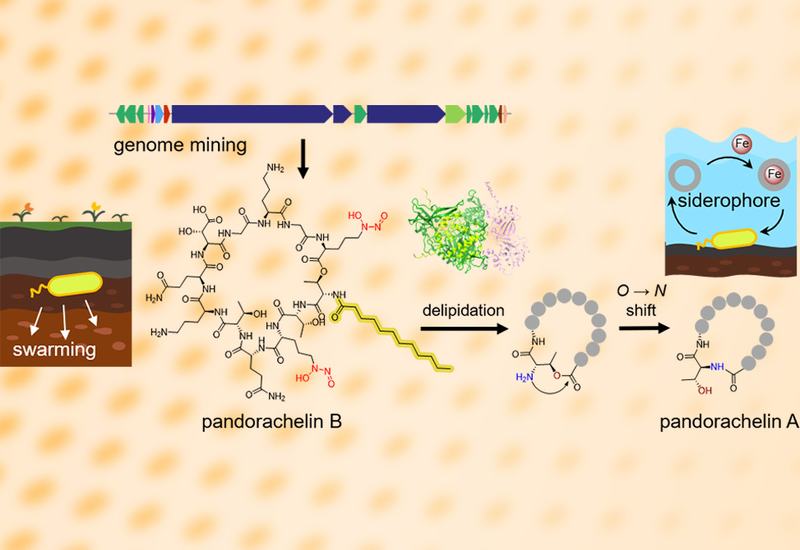
Researchers in the Hertweck Lab at the Leibniz Institute for Natural Product Research and Infection Biology, published in Angewandte Chemie International Edition, discovered that the pdn gene cluster encodes two structurally distinct but biosynthetically linked cyclopeptides: pandorachelin B, a lipocyclopeptide bearing a dodecanoyl chain and a lactone ring closure, and pandorachelin A, a head-to-tail homodetic cyclopeptide that forms when the specialized acylase PdnM cleaves the fatty acid tail. That cleavage liberates the N-terminal threonine amine, which spontaneously attacks the adjacent lactone carbonyl in an O→N acyl shift, contracting and remodeling the ring. Genetic knockouts confirmed that PdnM is both necessary and sufficient for the conversion: a pdnM deletion mutant accumulates only the lipopeptide precursor, while recombinant PdnM reconstitutes the full transformation in vitro. The functional consequences are sharp: pandorachelin B acts as a biosurfactant enabling swarming motility, whereas pandorachelin A, the delipidated product, binds Fe³⁺ with measurably greater potency.

The ecological logic becomes clear when comparing strains by habitat: the soil-dwelling Pandoraea horticolens retains substantial pandorachelin B and swarms, while the aquatic Pandoraea norimbergensis converts nearly all precursor to the chelator. PdnM activity level, not gene expression, appears to govern the ratio between forms, pointing to the acylase as a tunable switch for niche adaptation. The identification of PdnM as a potential antivirulence target, and the broader principle that NRPS-derived lipopeptides may encode cryptic dual functions resolved by post-assembly enzymatic editing, invites a fresh look at related biosynthetic pathways across the microbial world.


Author

Dr. Keishi Ishida received his Ph.D. in 1999 from the Graduate School of Agricultural and Life Sciences at the University of Tokyo under the direction of Professor Masahiro Murakami. He continued working with Professor Masahiro Murakami as a postdoctoral fellow from 1999 to 2002, before moving to Germany to pursue postdoctoral research with Professor Thomas Börner and Professor Elke Dittmann at the Humboldt University of Berlin from 2002 to 2005. Since 2005, he has been a postdoctoral fellow in the laboratory of Professor Christian Hertweck, Department of Biomolecular Chemistry, at the Leibniz Institute for Natural Product Research and Infection Biology – Hans Knöll Institute, Leibniz-HKI, in Jena, Germany. His current research focuses on the discovery, biosynthesis, and function of novel natural products from diverse bacteria, with an emphasis on structural elucidation and exploring the mechanisms of enzyme catalysis.

Author

Christian Hertweck is Head of the Department of Biomolecular Chemistry at the Leibniz Institute for Natural Product Research and Infection Biology, Leibniz-HKI, and holds a Chair at the Friedrich Schiller University Jena. After a Ph.D. in Organic Chemistry at the University of Bonn and the Max Planck Institute for Chemical Ecology, he was a Feodor Lynen postdoctoral fellow at teh University of Washington at Seattle. His research focuses on the specialized metabolites of neglected microbes, utilizing genome mining, metabolic engineering, and synthetic biology to study their functions and biosynthesis. He has co-authored more than 400 publications and patents. He is an elected member of the German National Academy of Sciences Leopoldina and has received the Leibniz Award, the Ernst Jung Prize for Medicine, and an ERC Advanced Grant.

Photo by Anna Schroll/Leibniz-HKI, 2021

Siderophore Shape-Shifting

Author

Elena Herzog received her B.Sc. in Chemistry from University of Bayreuth, Germany in 2018. She continued her studies in natural product and drug chemistry at University of Bayreuth, and was awarded her M.Sc. in 2021. She is currently finalizing her Ph.D. in Biomolecular Chemistry under the supervision of Professor Christian Hertweck at the Leibniz Institute for Natural Product Research and Infection Biology – Hans Knöll Institute, Leibniz-HKI, in Jena, Germany. Her doctoral research focuses on the discovery, isolation, and characterization of bioactive natural products by way of a combination of bioinformatic, chromatographic, spectrometric, and spectroscopic methods. Her research interests include natural product chemistry and peptide chemistry, with a particular fascination for applying analytical chemistry to explore how the structures of natural products arise from their underlying biosynthetic pathways.